Watch: Complete Setup Guide
Follow along with our comprehensive video tutorial to get started quickly
Welcome to Sage CRM!
Initial Setup Checklist
1 Complete App Settings
Configure your business information, notification preferences, and contact details.
2 Configure SMS Settings
Set up your SMS gateway (Termii or Kudisms) to send order notifications to customers.
3 Add Products and Packages
Create your product catalog and package bundles for easy order processing.
4 Create User Accounts
Add your team members and assign appropriate roles (Staff, Supervisor, Accountant).
5 Set Up Product Form
Create an embeddable order form for your website or share the link with customers.
App Settings
Configure your business information and notification preferences to personalize your CRM experience.
Business Information
Business Name
Your company name that appears in emails and notifications.
Business Email
Primary email address for system notifications and customer communications.
Customer Support Phone
Contact number that will be included in SMS messages to customers.
Notification Settings
Daily Order Summaries
Receive email summaries of daily orders, revenue, and key metrics.
Low Stock Alerts
Get notified when product inventory falls below threshold levels.
Notification Recipients
Add multiple email addresses to receive system notifications (comma-separated).
Abandoned Order Alert
Set how many minutes before flagging orders stuck in "New" status (default: 35 minutes).
Cart Expiry Period
Set when abandoned carts should be archived as expired (default: 7 days).
Default Country Setting
Default Country
Set your primary business country to simplify operations. Navigate to Admin Panel → General Settings and select a country in the "Default Country" field. New customers and orders will default to this country if not specified.
When to Use
If you operate primarily in one country, setting it as default saves time when creating customers and orders. For multi-country businesses, you can leave it blank and specify the country for each record.
SMS Settings
Configure your SMS gateway to automatically send order status updates to your customers.
Gateway Selection
Choose your preferred SMS service provider:
Termii
- Support for Generic and DND channels
- Balance checking available
- Reliable delivery
Kudisms
- Corporate SMS API
- Auto-balance updates
- Competitive pricing
API Credentials Setup
API Key
Your unique API key from your SMS provider's dashboard.
Sender ID
The name that appears as the sender of your SMS messages (must be approved by provider).
SMS Channel (Termii Only)
Choose between Generic (all numbers) or DND (Do Not Disturb numbers only).
Order Status Notifications
Enable SMS notifications for specific order statuses:
SMS Balance
Termii
Check your SMS balance anytime using the "Check Balance" button in settings.
Kudisms
Your balance is automatically updated after each SMS is sent.
VAT & Tax Compliance
Manage VAT calculations, generate invoices, and export tax reports with ease. VAT rates are configured per country, ensuring accurate tax calculations for each market. Everything you need to stay compliant and simplify year-end filing.
VAT Rate Configuration
VAT rates are configured per country, allowing different rates for different markets:
Per-Country VAT Rates
Each country has its own default VAT rate (e.g., Nigeria: 7.5%, Ghana: 12.5%). Navigate to Admin Panel → Countries to view or edit each country's VAT rate.
How It Works
When an order is created, the system automatically uses the VAT rate from the order's country. Orders from Nigeria use Nigeria's rate, orders from Ghana use Ghana's rate, and so on.
Updating VAT Rates
To change a country's VAT rate, edit the country in Admin Panel → Countries and update the "Default VAT Rate" field. After changing, use the "Recalculate VAT" button on the Tax Reports page (with country filter) to update existing orders for that country.
VAT-Inclusive Pricing
All product prices in Sage CRM are VAT-inclusive:
Example Calculation (Nigeria, 7.5% VAT):
- Product Price: ₦10,000.00
- Subtotal (excl. VAT): ₦9,302.33
- VAT Amount (7.5%): ₦697.67
- Total: ₦10,000.00
Formula: Subtotal = Total ÷ (1 + VAT Rate)
Note: The VAT rate used depends on the order's country. Different countries have different rates (e.g., Nigeria: 7.5%, Ghana: 12.5%).
VAT-Exempt Products
Mark products as VAT-exempt according to your country's tax authority guidelines. VAT exemption rules vary by country.
How to Mark Products
Navigate to Admin Panel → Products → Edit Product, then check the "VAT-Exempt" checkbox. Exempt products won't have VAT calculated on their orders.
Common Exempt Categories
While exemption rules vary by country, common exempt categories often include:
- Basic food items (staples, fresh produce)
- Healthcare products and services
- Educational materials and services
- Electricity and essential utilities
Note: Check with your country's tax authority for the official list of VAT-exempt products.
Tax Reports Dashboard
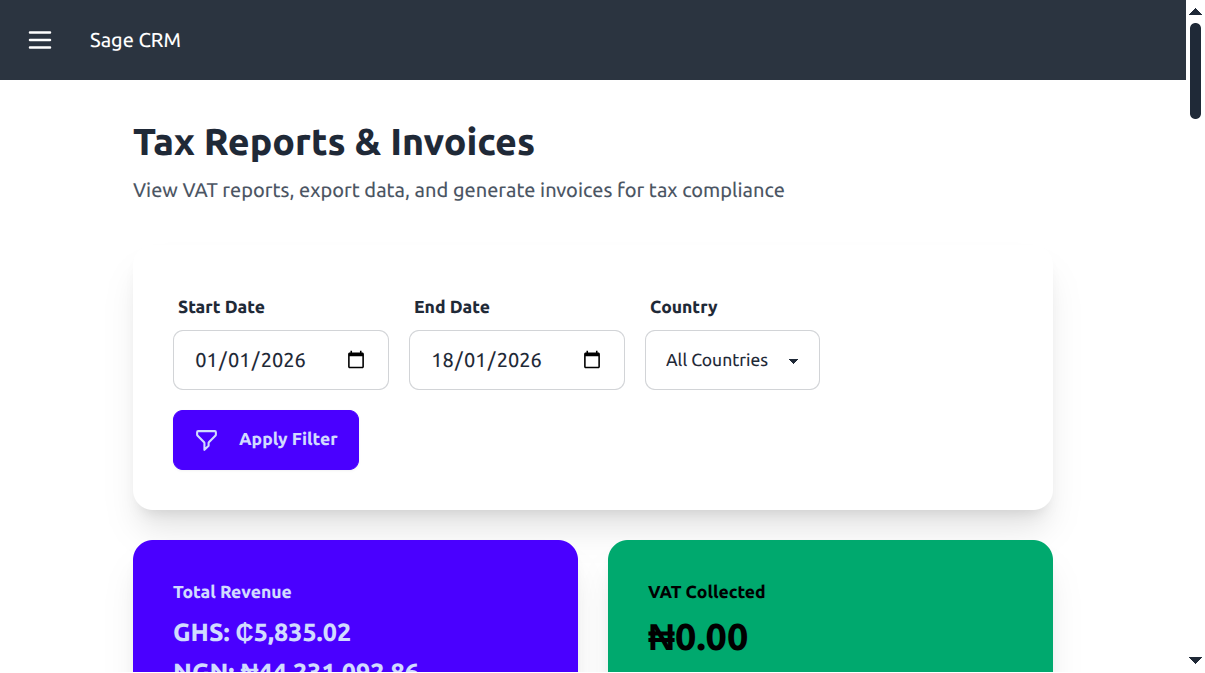
Access comprehensive VAT reports from the Dashboard → Tax Reports menu:
Summary Cards:
Filtering Options:
- Filter by country using the country dropdown (view reports for specific countries)
- Filter by custom date range (start date to end date)
- View detailed order breakdown with VAT per order
- See invoice status for each order
- Revenue totals show breakdown by country and currency
Available Actions
Export VAT Report (CSV)
Download complete VAT report with all order details for accountant or tax filing. Reports can be filtered by country for per-country tax compliance.
Generate Missing Invoices
Create sequential invoice numbers with country prefixes (INV-NG-2026-0001, INV-GH-2026-0001, etc.) for orders without invoices.
Recalculate VAT
Update all orders with the current VAT rate (Admin only). Use after changing VAT rate in settings.
Invoice Generation
Sequential Numbering with Country Prefixes
Invoices are auto-numbered with country prefixes: INV-NG-2026-0001 (Nigeria), INV-GH-2026-0001 (Ghana), etc. Each country maintains its own sequential numbering.
Invoice Details Include:
- Business name and contact information
- Customer details (name, phone, address)
- Order items with quantities and prices
- VAT breakdown (Subtotal + VAT = Total)
- Invoice number and date
Access Invoices
Click the invoice link in the Tax Reports table, or visit Orders → Order Detail → Generate Invoice.
CSV Export Format
Exported VAT reports include the following columns:
| Column | Description |
|---|---|
| Order ID | Unique order identifier |
| Date | Order creation date |
| Customer Name | Full customer name |
| Customer Phone | Contact number |
| Products | Ordered items |
| Country | Country of the order |
| Subtotal | Amount before VAT (in order's currency) |
| VAT Amount | Calculated VAT (in order's currency) |
| Total | Final amount including VAT (in order's currency) |
| Invoice Number | Sequential invoice number with country prefix |
| VAT Status | Taxable or Exempt |
Who Can Access Tax Reports?
Year-End Tax Filing Workflow
Follow these steps for smooth tax compliance:
-
1
Set Date Range and Country (if needed)
Navigate to Tax Reports and set the date range (e.g., Jan 1 - Dec 31, 2026). For multi-country businesses, select the country filter if you need country-specific reports.
-
2
Review Summary
Check the 4 summary cards to verify total revenue, VAT collected, and taxable vs exempt sales. Revenue breakdown shows per country and currency.
-
3
Generate Invoices
Click "Generate Missing Invoices" to create invoice numbers with country prefixes (INV-NG-2026-0001, INV-GH-2026-0001, etc.) for all orders.
-
4
Export CSV Report
Click "Export VAT Report (CSV)" to download the complete report. You can filter by country first to export per-country reports.
-
5
Share with Accountant
Send the CSV file to your accountant or use it for tax filing. For multi-country businesses, export separate reports per country if needed for country-specific tax compliance.
Multi-Country Setup
Manage your business across multiple countries with different currencies, VAT rates, and regional settings. Sage CRM supports operations in Nigeria, Ghana, and other West African countries, with independent configurations for each country.
Understanding Multi-Country Features
The multi-country feature allows you to:
Country-Specific Orders & Customers
Every order and customer is linked to a specific country. This helps you track which countries generate the most business.
Different VAT Rates Per Country
Each country can have its own VAT rate (e.g., Nigeria: 7.5%, Ghana: 12.5%). Tax reports automatically use the correct rate for each order.
Multi-Currency Support
Each country has its own currency (NGN for Nigeria, GHS for Ghana, etc.). Orders display amounts in their country's currency symbol.
Country-Specific Invoice & Waybill Numbers
Invoices use country prefixes (INV-NG-2026-0001 for Nigeria, INV-GH-2026-0001 for Ghana). Same for waybill numbers (WB-NG, WB-GH).
Regional Organization
States, provinces, or regions are organized by country. When selecting a region in forms, you'll only see regions for the selected country.
Managing Countries
Countries are pre-populated when you first set up your CRM. To manage them:
Access Countries List
Navigate to Admin Panel → Countries to view all available countries.
Country Information
Each country displays:
- Name & Code: Country name (e.g., "Nigeria") and ISO code (e.g., "NG")
- Currency: The default currency for this country (e.g., NGN, GHS)
- Default VAT Rate: The standard VAT percentage (e.g., 7.5%, 12.5%)
- Timezone: Country's timezone (e.g., Africa/Lagos)
- Invoice Prefix: Used in invoice numbers (e.g., INV-NG, INV-GH)
- Waybill Prefix: Used in waybill numbers (e.g., WB-NG, WB-GH)
- Active Status: Whether the country is available for selection
Activating/Deactivating Countries
You can activate or deactivate countries by editing them. Inactive countries won't appear in dropdown menus but existing data remains intact.
Managing Currencies
Currencies are linked to countries and determine how amounts are displayed.
Access Currencies
Navigate to Admin Panel → Currencies to view all available currencies.
Currency Information
Each currency shows:
- Code: ISO currency code (e.g., NGN, GHS, XOF)
- Name: Full currency name (e.g., Nigerian Naira, Ghanaian Cedi)
- Symbol: Currency symbol (e.g., ₦, ₵, CFA)
- Decimal Places: How many decimal places to show (usually 2)
How Currencies Are Used
When you create an order, the currency is automatically set based on the customer's country or the product form's country. Orders display amounts with their country's currency symbol (e.g., ₦10,000 or ₵500).
Common Currencies
The system includes common West African currencies:
- NGN - Nigerian Naira (₦) - Used in Nigeria
- GHS - Ghanaian Cedi (₵) - Used in Ghana
- XOF - West African CFA Franc (CFA) - Used in other West African countries
Managing Regions (States/Provinces)
Regions represent states, provinces, or administrative areas within each country.
Access Regions
Navigate to Admin Panel → Regions to view all regions organized by country.
Region Organization
Regions are organized by country:
- Nigeria: All 36 states plus FCT (e.g., Lagos, Abuja, Kano)
- Ghana: 16 regions (e.g., Greater Accra, Ashanti, Northern)
- Other countries will have their regions as configured
How Regions Work in Forms
When creating customers or orders, the region dropdown automatically shows only regions for the selected country. For example, if you select Nigeria, you'll see Nigerian states. If you select Ghana, you'll see Ghana regions.
Setting Default Country
Set your primary business country to simplify operations if you mainly operate in one country.
Where to Set Default Country
Navigate to Admin Panel → General Settings (App Settings) and find the "Default Country" field.
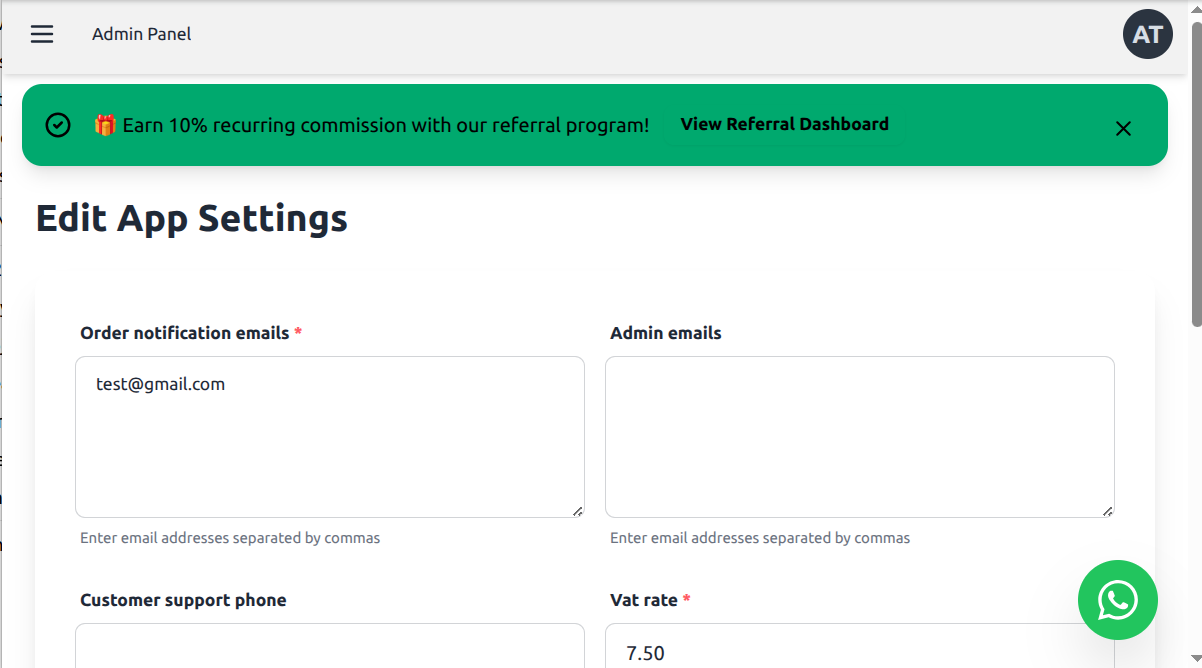
What Default Country Does
Setting a default country ensures:
- New customers are automatically assigned this country if not specified
- Orders use this country as a fallback when country isn't specified
- Product forms can default to this country when creating new forms
When to Set a Default
If your business operates primarily in one country (e.g., only Nigeria), setting it as default saves time. If you operate in multiple countries equally, you can leave it blank and specify the country for each customer and order.
Assigning Countries to Product Forms
Product forms must have a country assigned, which determines currency and available regions.
Creating/Editing Product Forms
When creating or editing a product form in Admin Panel → Product Forms, the Country field is required.
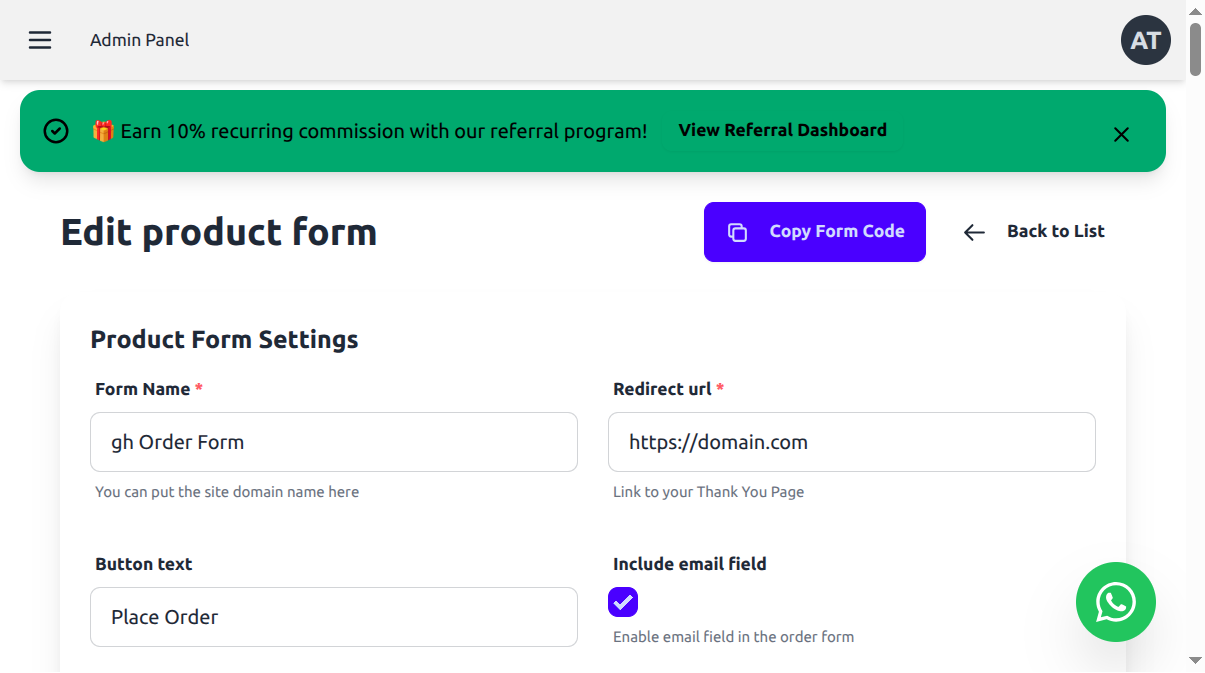
What Country Selection Affects
Selecting a country for your product form:
- Sets Currency: All packages in this form will use the country's currency (e.g., NGN for Nigeria, GHS for Ghana)
- Filters Regions: Customer address forms will show only regions from this country
- Sets VAT Rate: Orders from this form will use the country's default VAT rate
- Determines Invoice Prefix: Generated invoices will use the country's prefix
Products vs Product Forms
Products themselves are country-agnostic (a "Widget" can be sold in any country). Product forms link products to specific countries. Create separate product forms for each country where you sell the same products.
Packages and Currency
When you create packages in a product form, the currency is automatically set based on the form's country. You don't need to manually set currency for each package.
Country-Based Access Control
Control which countries your staff members can access to ensure proper data visibility and security.
Setting Country Access for Users
Navigate to Admin Panel → Users, then edit any user. Find the "Countries" field, which shows a list of checkboxes for each country.
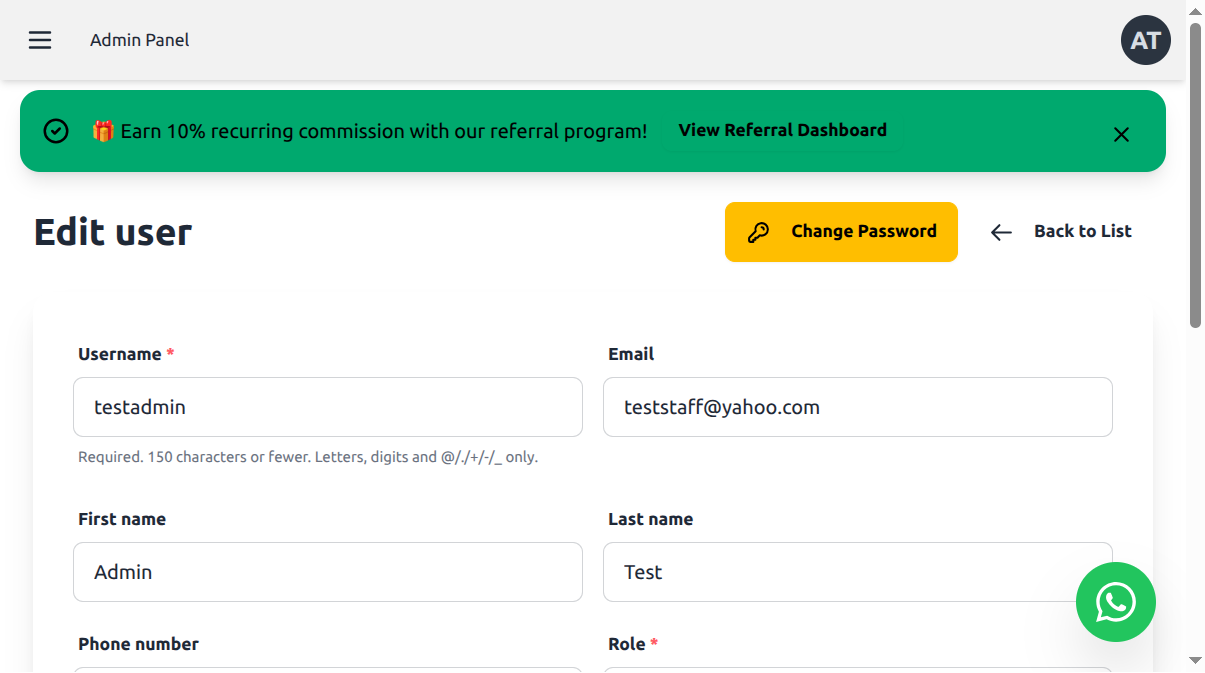
How It Works
Leave Empty (No Countries Selected):
User can access data from all countries. This is the default for unrestricted access (useful for admins, supervisors).
Select Specific Countries:
User can only see and access data (orders, customers, reports) from the selected countries. Data from other countries will be hidden.
Use Cases
- Regional Teams: Staff assigned to Nigeria only see Nigeria orders and customers
- Country Managers: Managers responsible for specific countries see only their country's data
- Multi-Brand Operations: Different teams handling different countries within the same CRM
- Data Security: Ensure staff only access data relevant to their role
How Multi-Country Affects Your Operations
Multi-country settings impact various parts of your CRM operations. Here's where you'll see country-specific information:
Orders
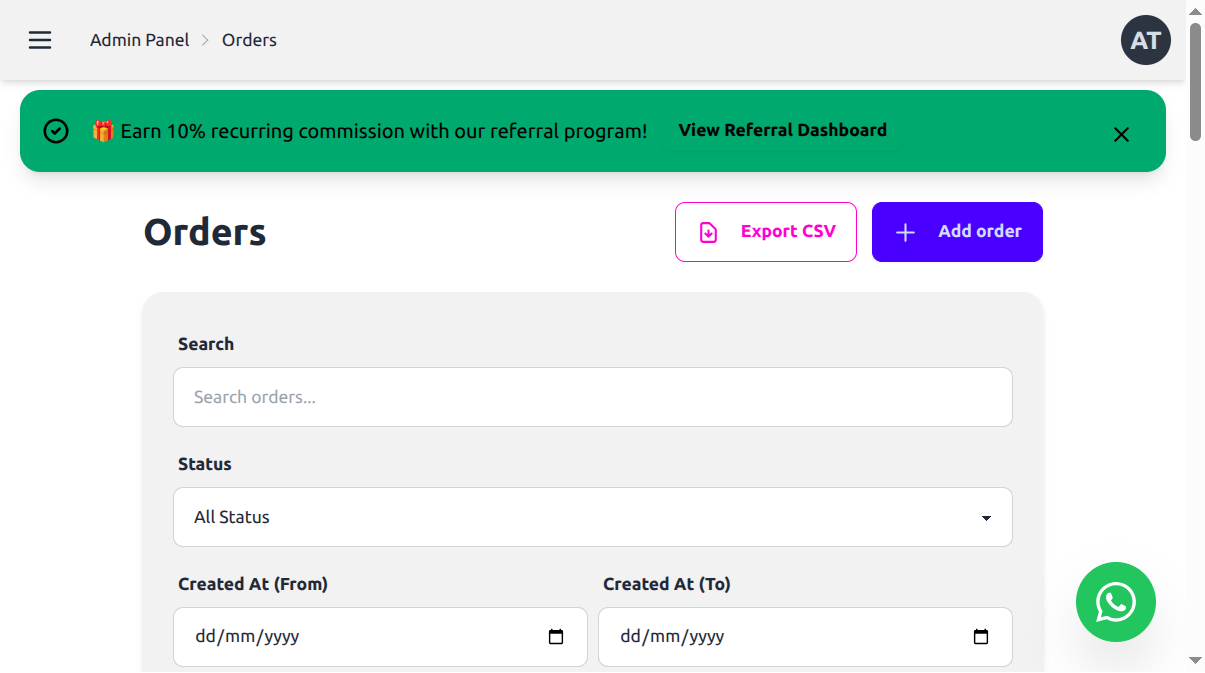
- Each order shows a country badge (e.g., "NG", "GH") in order lists
- Orders display amounts in their country's currency (₦, ₵, etc.)
- Filter orders by country using the country dropdown in order lists
- Revenue summaries show breakdown by currency on the dashboard
Customers
- Customer lists display country badges next to each customer name
- Filter customers by country in the customer list page
- Customer forms automatically show regions for the selected country
VAT & Tax Reports
- Tax Reports page includes a country selector dropdown
- VAT calculations automatically use each country's specific rate
- Revenue breakdown shows totals per country and currency
Invoices
- Invoice numbers use country prefixes: INV-NG-2026-0001 (Nigeria) vs INV-GH-2026-0001 (Ghana)
- Each country maintains its own sequential numbering
- Amounts display in the order's currency symbol
Waybills
- Waybill numbers use country prefixes: WB-NG-20260117-001 (Nigeria) vs WB-GH-20260117-001 (Ghana)
- Waybill lists show country badges and can be filtered by country
- Each country has its own waybill numbering sequence
Dashboard & Statistics
- Revenue cards show breakdown by currency (e.g., "NGN: ₦50,000" and "GHS: ₵2,000")
- Stats page includes country performance breakdown table
- Quick filter badges for each country on the Stats page
- Country-specific metrics (orders, revenue, customers) are calculated separately
Multi-Country Best Practices
Follow these tips to get the most out of multi-country features:
Set Default Country
If you operate primarily in one country, set it as default in General Settings. This ensures new customers and orders default to the correct country.
Assign Countries to Users
Use country access control to restrict staff to their assigned countries. This improves data security and prevents confusion.
Always Assign Countries to Product Forms
Every product form must have a country. This ensures correct currency, VAT rates, and region filtering for orders created through that form.
Verify Country When Creating Orders Manually
When creating orders through the Admin Panel, double-check that the country is correctly set. This ensures proper currency and VAT calculations.
Use Country Filtering in Reports
Filter reports by country to analyze performance per country. This helps with country-specific business decisions and tax filing.
Review Country Settings Periodically
If VAT rates change in a country, update the country's default VAT rate. Recalculate VAT for existing orders if needed using the Tax Reports page.
User Roles & Permissions
Sage CRM offers 4 user roles to help you manage your team effectively. Each role has specific permissions tailored to their responsibilities.
Admin (Business Owner)
Full CRM access - Intended for business owners or managers.
Can Access:
- All dashboard features and reports
- Complete Admin Panel access
- Order, customer, and inventory management
- Payment records and financial data
- Staff performance and statistics
- SMS marketing and ad spend tracking
- User management and settings
- Subscription and billing management
Supervisor
Management features - For team leads and operations managers.
Can Access:
- Dashboard and orders
- Customer management
- Payment records
- Inventory management
- Staff performance reports
- CRM statistics and analytics
- SMS marketing
- Ad spend tracking
Accountant
Financial features - For accounting and finance personnel.
Can Access:
- Dashboard and orders
- Customer information
- Payment records (view, create, edit)
- Inventory management
- Tax reports and VAT compliance
- Financial reports
Staff
Basic order management - For order processing and customer service teams.
Can Access:
- Dashboard (orders assigned to them)
- View and update order status
- View customer information
- Process deliveries
- Update inventory (agents only)
Quick Permissions Comparison
| Feature | Admin | Supervisor | Accountant | Staff |
|---|---|---|---|---|
| Orders Management | ||||
| Customer Management | ||||
| Payment Records | ||||
| Inventory | ||||
| Statistics & Reports | ||||
| Staff Performance | ||||
| SMS Marketing | ||||
| Ad Spend Tracker | ||||
| Admin Panel | ||||
| Tax Reports & VAT | ||||
| User Management |
Admin Panel Guide
The Admin Panel is your control center for managing all aspects of your CRM. Only Admin users have access to these features.
Orders Management
Comprehensive order management with advanced filtering and export capabilities.
Features:
- View all orders with detailed information
- Filter by status, date, assigned staff, and more
- Bulk actions for efficient processing
- Export orders to CSV/Excel
- Track order history and status changes
Abandoned Carts
Manage captured abandoned carts from your order forms:
- View all captured abandoned carts
- Filter by status (Active, Converted, Contacted)
- Export to CSV for follow-up campaigns
- Search by customer name or phone number
- Edit or delete cart records as needed
Customer Management
Maintain your customer database with complete contact information and order history.
Features:
- Add, edit, and manage customer profiles
- View complete order history per customer
- Search and filter customer database
- Export customer lists
- Track customer lifetime value
Products & Packages
Create and manage your product catalog and bundle packages.
Features:
- Add products with pricing and descriptions
- Create package bundles for combo deals
- Manage product availability
- Set up product forms for online ordering
- Generate embeddable order forms
Inventory Tracking
Monitor stock levels and agent inventory for efficient operations.
Features:
- Track product stock levels
- Monitor agent inventory
- Low stock alerts and notifications
- Inventory movement reports
- Stock adjustment capabilities
Payment Records
Track and manage all payment transactions with detailed records.
Features:
- Record payments for orders
- View payment history and summaries
- Filter by date, amount, and status
- Export payment reports
- Track who recorded each payment
SMS Marketing
Send targeted SMS campaigns to your customer base.
Features:
- Create and save SMS templates
- Send bulk SMS to customer segments
- Filter customers by order status or date
- Track SMS delivery and logs
- Monitor SMS balance
Ad Spend Tracking
Monitor your advertising expenses across different platforms.
Features:
- Create ad accounts for different platforms
- Track daily ad spending
- Compare ad spend vs revenue
- View spending trends and analytics
- Export ad spend reports
User Management
Create and manage user accounts for your team members.
Features:
- Add new users with roles
- Edit user information and permissions
- Set maximum orders per day for staff
- Reset user passwords
- Activate or deactivate accounts
Referral Program
Earn money by referring other businesses to Sage CRM! Get 10% commission on every subscription renewal from your referrals.
How to Get Started
Get Your Referral Link
Visit the Admin Panel → Referrals to find your unique referral link and code.
Share With Others
Share your referral link with other businesses via email, social media, or word of mouth.
Earn Commissions
When they sign up and renew their subscription, you earn 10% commission automatically.
Track Your Earnings
Your Referrals dashboard shows:
- Total businesses you've referred
- Total commissions earned
- Amount available for withdrawal
- Pending withdrawal requests
- Payment history
Withdraw Your Earnings
Minimum Withdrawal
You can request a withdrawal once your balance reaches ₦5,000.
How to Request
Go to Admin Panel → Referrals and click the "Request Withdrawal" button.
Processing Time
Withdrawal requests are reviewed and processed within 3-5 business days.
Advanced Order Features
Sage CRM includes powerful features to help you manage orders efficiently and never miss a sale opportunity.
Tomorrow's Orders
Quickly see which orders are scheduled for delivery tomorrow so your team can prepare ahead of time.
Benefits:
- Plan delivery routes in advance
- Staff see only their assigned orders
- Managers see all tomorrow's orders at a glance
- Filter by agent or search for specific orders
Access: Orders menu → Tomorrow's Orders
Abandoned Orders
Never let an order slip through the cracks! This feature automatically identifies orders that have been sitting in "New" status for too long.
What It Does:
- Flags orders that need immediate attention
- Shows how long each order has been waiting
- Helps you follow up with customers quickly
- Reduces lost sales from forgotten orders
Available to: Admin and Supervisor roles only
Customizable: Set your preferred alert time in App Settings (default: 35 minutes)
Abandoned Cart Recovery
Capture potential customers who start filling out your order form but leave before submitting. Turn interested visitors into paying customers!
How It Works:
When someone types their name and phone number in your order form, we save it automatically
Track repeat visitors - customers who abandon multiple times are flagged as "High Interest"
Access the list from Orders menu → Abandoned Carts
What You Can Do:
- Call them back - All contact information is saved
- Convert with one click - Turn abandoned carts into orders instantly
- Mark as contacted - Track your follow-up efforts
- Filter and search - Find specific customers easily
- Export to CSV - Download lists for calling campaigns
High-Interest Customers
Customers who abandon 3 or more times are automatically flagged - they're clearly interested and just need a nudge!